

描述
Operate WordPress like modern infrastructure — turn any WordPress do_action into a first-class automation trigger your CRMs, n8n flows, AI agents, and internal services can consume.
📖 Full documentation at wpwebhooks.org/docs/
Core features (free)
- Persistent delivery queue with smart retry and exponential backoff — powered by WP-Cron, auto-upgrades to Action Scheduler or System Cron when available, (Pro) External Cron for guaranteed reliability
- Per-event UUID and ISO 8601 timestamp — enable downstream deduplication
- Delivery logs with full attempt history, request/response inspection, replay, and bulk retry
- Synchronous execution mode — fire inline without queue delay
- Payload mapping — rename, restructure, exclude, and type-cast fields with dot-notation paths
- Conditional dispatch — filter events by payload field values before dispatch
- HTTP method, custom headers, and URL query parameters per webhook
- Dynamic endpoint URLs —
{{ field.path }}placeholders resolved at dispatch time (free viafswa_webhook_urlfilter) - Webhook Chains — wire 2xx completions to downstream webhooks with full observability
- Credentials Vault — store reusable auth secrets (Bearer, Basic, API key, custom) encrypted at rest; reference them from webhooks instead of pasting raw Authorization headers. Secrets are write-only over the API — never returned, only a masked hint
- Activity History — persistent audit log of every admin and API-token action
- Built-in CF7 and IvyForms integrations — structured payloads, no extra plugins
- Action Scheduler auto-detection — more reliable delivery on high-traffic sites
- Full REST API with scoped API token authentication (
read/operational/full/agent) — theagentscope grants full write access for AI assistants while never exposing stored secrets - Developer extensibility — 16 filters and 7 action hooks (reference)
Pro features
- Code Glue — attach PHP snippets to any webhook+trigger (pre-dispatch payload enrichment, post-dispatch side effects)
- External Cron — replace unreliable visitor-triggered WP-Cron with a managed external pinger, provisioned automatically on license activation. Two modes: plugin queue endpoint (down to 20 s interval, configurable batch size) or WP-Cron endpoint (60 s, covers all WordPress background work). No server crontab or external dashboard — controlled entirely from wp-admin, with a live heartbeat chart and inline error alerts
- Unlimited conditions per trigger with AND/OR groups
- Per-webhook retry limit and backoff strategy overrides
- Dynamic URL templates —
{{ }}syntax with no custom PHP required
Examples
- Send Contact Form 7 submissions to a webhook (n8n demo)
- Send Gravity Forms Submissions to n8n
- Send IvyForms submissions to a webhook (n8n demo)
- WooCommerce orders to n8n on completion — wired up with a Claude Code agent
- WooCommerce to HubSpot integration — sync orders, contacts, and deals with no custom code
屏幕截图




安装
- Upload the plugin files to the
/wp-content/plugins/flowsystems-webhook-actionsdirectory, or install the plugin through the WordPress plugins screen. - Activate the plugin through the ‘Plugins’ screen in WordPress.
- Navigate to Webhook Actions in the admin menu.
- Add your webhook endpoint URL and select the desired WordPress action triggers.
常见问题
-
Is this plugin free?
-
Yes. The core plugin is completely free and licensed under GPL. Webhook Actions Pro is an optional paid upgrade that adds unlimited conditions, per-webhook retry and backoff settings, Code Glue snippets, External Cron (activated automatically on license activation), and more. Learn more
-
Does it work with WooCommerce, n8n, Make, Zapier, and AI agents?
-
Yes. Any WordPress or WooCommerce action can be a trigger. The plugin delivers to any HTTP endpoint — n8n, Make, Zapier webhook nodes, internal services, or AI agent APIs. Scoped API tokens let Claude Code, Cursor, or any automation tool read logs, retry deliveries, and toggle webhooks without WordPress credentials.
-
Do I need extra plugins for Contact Form 7 or IvyForms?
-
No. Both integrations are built in. When CF7 or IvyForms is active, submissions are automatically normalized into clean JSON payloads — no additional plugins or custom code required.
-
How does retry work?
-
5xx and 429 responses retry automatically with exponential backoff (delays of ~30s, 60s, 120s, 240s, 480s, capped at 1 hour). 4xx and 3xx responses are marked
permanently_failedimmediately — bad payloads are not worth retrying. Default maximum is 5 attempts; override with thefswa_max_attemptsfilter or (Pro) per-webhook settings. -
Can I access the REST API without a WordPress login?
-
Yes. Create a token from the API Tokens screen and pass it as
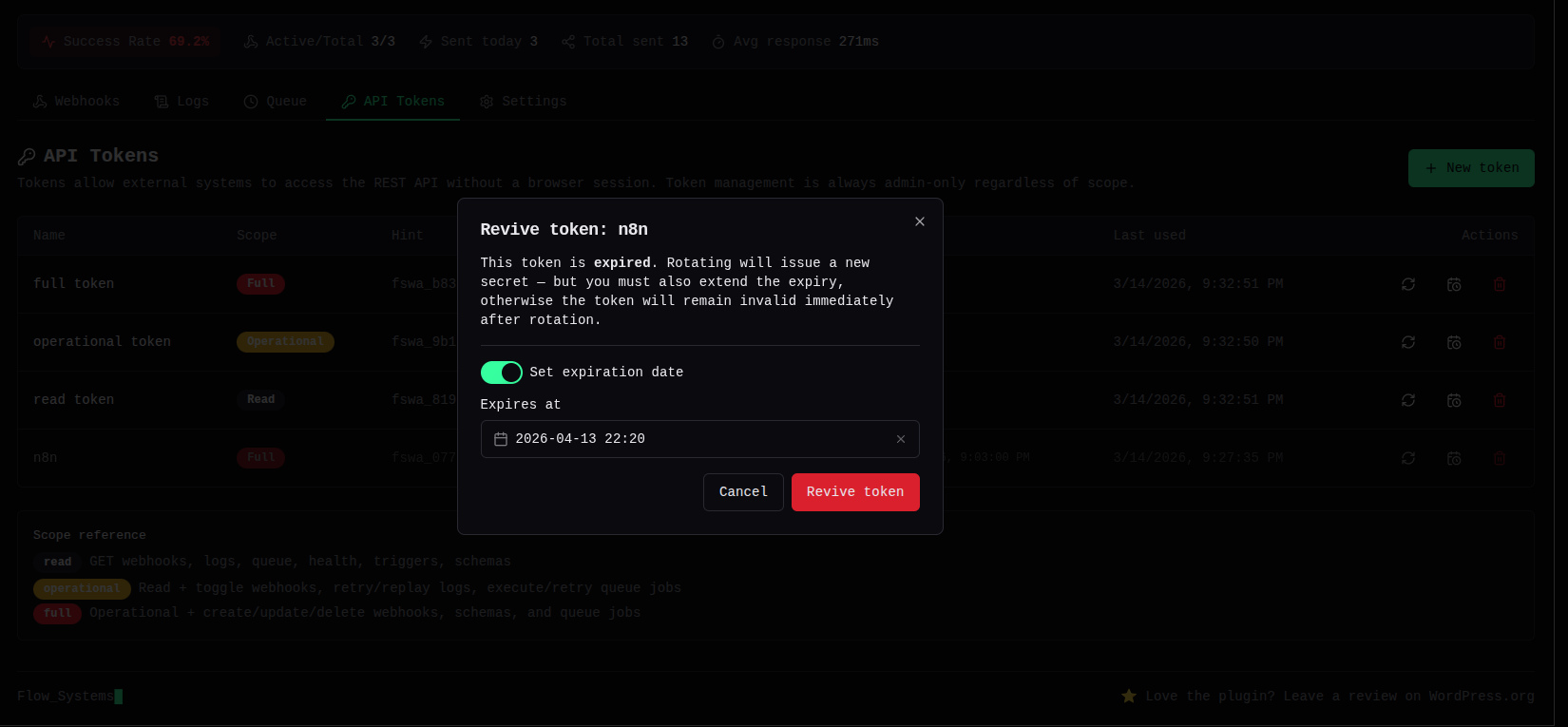
X-FSWA-Token: <token>(orAuthorization: Bearer). Three scopes available —read,operational,full— so you can grant exactly the access each integration needs. Full API reference at wpwebhooks.org/webhook-wordpress-plugin-api/
评价


贡献者及开发者

更新日志
For the full release history see wpwebhooks.org/changelog/
1.15.0 — 2026-06-07
- New: Credentials Vault — store reusable authentication secrets (Bearer token, Basic auth, API key, custom header) encrypted at rest with AES-256-GCM, and reference them from webhooks via a saved credential instead of a raw Authorization header
- New: Write-only secrets — vault values are never returned by the REST API; only a masked hint is shown. Decrypted only at dispatch time to build the outgoing header
- New:
agentAPI token scope — full write access (create/update/delete webhooks and credentials) for AI assistants, but can never reveal auth headers or vault secrets - New:
FSWA_SECRET_KEYwp-config constant (optional) — move the encryption key out of the database for stronger protection, with a one-click in-app migration that re-encrypts existing credentials and removes the database key - New: “Save to vault” action on the webhook form — migrate an existing manual Authorization header into the vault in one step
- Improved: Resolved Authorization/custom auth headers are redacted in delivery logs
- Developer: New REST endpoints under
/fswa/v1/credentials(CRUD,key-status,reencrypt); webhooks accept anauth_credential_idreference