

描述
PSB Bot Traffic Controller sits in front of your WordPress site and classifies incoming traffic
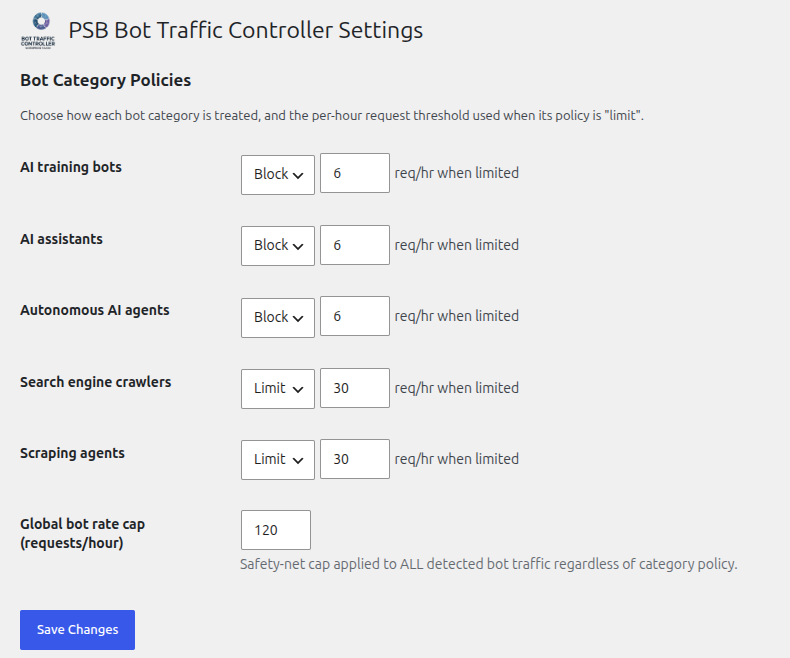
into five bot categories:
- AI training bots
- AI assistants
- Autonomous AI agents
- Search engine crawlers
- Scraping agents
Each category can be configured independently to block (HTTP 403), rate-limit (HTTP 429 once
a configurable per-hour threshold is exceeded), or allow traffic. A global safety-net cap also
applies to all detected bot traffic regardless of per-category policy.
Detection runs via a free, zero-dependency regex/User-Agent pattern engine by default, curated
from third-party bot-pattern data (see Credits below). An optional WURFL.js-based detection
engine can be enabled for higher accuracy.
For performance, bot interception runs as early as possible via a small mu-plugin installed
automatically into wp-content/mu-plugins/ — this avoids the cost of a full WordPress
bootstrap for traffic that ends up being blocked.
Credits
The bundled bot-pattern data (includes/detection/regex/data/bot-patterns.php) is built from
three third-party sources, each under a GPL-compatible license:
- matomo-org/device-detector — LGPL-3.0
- crawler-user-agents — MIT
- ai.robots.txt — MIT
No code from these projects is bundled — only pattern/name/category data, transformed at build
time (tools/cmd/build-patterns) into this plugin’s own runtime format.
This plugin makes no outbound HTTP requests and does not integrate with any third-party or
external service. Earlier versions of the bundled pattern data included a per-signature
producer field (an attribution URL crediting the upstream source of each entry); it has been
removed entirely, since it was never fetched or otherwise dereferenced by the plugin at
runtime.
屏幕截图
安装
- Upload the plugin zip via Plugins > Add New > Upload Plugin, or extract it into wp-content/plugins/psb-bot-traffic-controller/.
- Activate the plugin. This installs a small companion file into
wp-content/mu-plugins/(WordPress’s “must-use plugin” mechanism) that performs early bot interception. - Configure per-category policy under Settings > PSB Bot Traffic Controller.
常见问题
-
Does this replace a WAF or CDN-level bot protection?
-
No — PSB Bot Traffic Controller runs inside WordPress (or, for the mu-plugin path, as early in
WordPress’s own bootstrap as possible) and cannot intercept traffic before it reaches your web
server. It complements, rather than replaces, edge-level protection. -
What happens if the mu-plugin file can’t be written on activation?
-
An admin notice is shown with the filesystem error. The plugin still activates, but early
interception won’t run until the mu-plugin is successfully installed (retry by
deactivating/reactivating, or check file permissions onwp-content/mu-plugins/). -
How do I reset rate-limit counters while testing?
-
Add
define( 'PSB_BTC_DEBUG', true );towp-config.phpon a staging/test site. This
enables a rotating-token reset URL shown on the Dashboard (valid for a few hours at a time,
then automatically expires). It is disabled by default and should never be enabled on a
production site.
评价
此插件暂无评价。
贡献者及开发者

更新日志
1.0.2
- Re-analyzed every remaining automated Plugin Check finding against this version’s actual
code, rather than restating prior documentation, and applied two genuine fixes found in the
process (both comment-only, zero behavior change): - Added
phpcs:ignore WordPress.DB.PreparedSQL.InterpolatedNotPreparedannotations to the
three interpolated-table-name queries inclass-ratelimit-store-db.php
(increment_and_get(),get_count(),cleanup_expired()) — this file had none, unlike its
siblingclass-ratelimit-reset.php, despite sharing the identical unfixable-by-design
pattern (table names can never be%s/%d$wpdb->prepare()placeholders). - Corrected
class-ratelimit-reset.php‘s existingphpcs:ignorecomment on its
TRUNCATE TABLE query: it previously named the sniffWordPress.DB.PreparedSQL.NotPrepared,
which is not what actually fires there — fixed to name
WordPress.DB.PreparedSQL.InterpolatedNotPrepared,PluginCheck.Security.DirectDB.UnescapedDBParameter,
matching what the checker actually reports, so the comment provides real suppression instead
of none.
1.0.1
- Regenerated the icon/banner/logo image assets from an updated source design (ring emblem +
“BOT TRAFFIC CONTROLLER” wordmark), replacing the placeholder artwork shipped in 1.0.0. - Sanitize
psb_btc_mu_respond()‘s output (strip control characters before echoing) rather
than relying on every current call site happening to pass a hardcoded literal — all 3 call
sites still do today, so this closes a latent gap rather than fixing a live exploit, but
escaping at the point of output shouldn’t depend on that staying true as the file is edited. - Re-reviewed the remaining automated Plugin Check findings against this version and confirmed
they remain the already-documented false positives / accepted architectural exceptions
covered inSUBMISSION.md(non-atomic-counterflock()locking has noWP_Filesystem
equivalent and must run pre-bootstrap;$wpdb->prepare()placeholders the checker’s static
analysis can’t trace through) — nothing else new to fix.
1.0.0
- Renamed the plugin from “botpolice” to “PSB Bot Traffic Controller” (slug
psb-bot-traffic-controller), following a WordPress.org plugin review finding that
“botpolice” too closely matched an existing project with overlapping functionality.
Every internal class/function/constant prefix, option/table/transient name, and
generated mu-plugin filename was renamed to match (Botpolice_*PSB_BTC_*,
botpolice_*psb_btc_*,BOTPOLICE_*PSB_BTC_*). - Removed the
producerattribution field from the bundled bot-pattern data
(includes/detection/regex/data/bot-patterns.php) — it held a URL in most entries and
was flagged twice by review under two headings (“calling files remotely” and
“undocumented use of a 3rd party/external service”), even though it was never
dereferenced as a URL anywhere in the runtime code. Removed entirely rather than
disclosed, since the plugin makes no outbound HTTP requests and integrates with no
external service. - Changed the mu-plugin’s per-category config cache from an executable
<?php return array(…); file to plain JSON (nowpsb-btc-config-cache.json,
read viajson_decode()), per a review finding against writing executable code
files intowp-content/mu-plugins/outside the small set of core-defined drop-in
exceptions. The mu-plugin bootstrap file itself and the (much larger) pattern-data
cache were not affected — review did not flag either of those. - Fixed a real correctness bug review’s automated tooling also caught: both the
object-cache-backed rate-limit store and the mu-plugin’s flat-file rate-limit
counters used a non-atomic read-increment-write sequence, letting concurrent
requests undercount and bypass configured limits. The object-cache store now uses
wp_cache_add()/wp_cache_incr()(atomic at the cache backend); the mu-plugin’s
flat-file counters now useflock()-based exclusive locking around the
read-modify-write. - Replaced the compound
if ( ! defined('ABSPATH') && ! defined('...STANDALONE') )
direct-access guard (used to allow PHPUnit to load classes without a full WP
install) with the literal bareif ( ! defined( 'ABSPATH' ) ) { exit; }review
expects, across all affected files. Test-only standalone loading now works by
having the PHPUnit bootstrap itself defineABSPATH, rather than each production
file special-casing a second constant.
0.4.1
- Address findings from the official WordPress Plugin Check tool: escape remaining
unescaped Dashboard output, switchclass-mu-installer.php‘s version-stamp read and
class-ratelimit-reset.php’s counter-file cleanup off raw file-handle/unlink()calls,
document the intentional nonce-free design of the (opt-in, off-by-default) debug reset
endpoint, add a direct-access guard to the generatedbot-patterns.php(via
tools/cmd/build-patterns, not by hand-editing the output), and correct “Tested up to”
to the current WordPress release. SeeSUBMISSION.mdfor a list of remaining Plugin
Check findings that are intentional design choices rather than defects (the
BOTPOLICE_STANDALONE direct-access guard variant, the mu-plugin’s necessarily-early
filesystem calls, and the reset endpoint’s token-based-not-nonce-based auth).
0.4.0
- The rate-limit-reset debug endpoint (
?botpolice_reset=<token>) is no longer loaded or
registered by default — it now requiresdefine( 'BOTPOLICE_DEBUG', true );in
wp-config.php to become reachable at all, rather than being an unauthenticated endpoint
present on every install.uninstall.phpalso now removes its secret option, if present. - Prepare for WordPress.org Plugin Directory submission: tightened the short description
to fit the directory’s display limit, corrected the “Tested up to” header (was a
nonexistent “7.0”), added a Screenshots section covering the Settings and Dashboard
admin pages, added a Credits section disclosing and licensing the bundled bot-pattern
data’s third-party sources, and fixed composer.json declaring “proprietary” while the
plugin itself is GPLv2 or later.
0.3.2
- Fix: the debug rate-limit-reset token (
?botpolice_reset=<token>, shown on the
Dashboard for manual testing) was a single fixed value stored inwp_options—
once leaked (screenshot, shared log, browser history), it stayed valid forever.
It now rotates automatically every 4 hours: the displayed/accepted token is an
HMAC-SHA256 of a persistent random secret (never displayed) and the current
4-hour time window, so a leaked token expires on its own without any manual
rotation step, and reading the plugin’s source alone is not enough to compute a
valid token (the algorithm is public; the secret it’s keyed on is not). The
Dashboard now also shows how many minutes remain before the current URL expires.
0.3.1
- Add the product logo/emblem to the Settings and Dashboard admin page headers
(assets/images/logo.png, shipped in the plugin zip) and WordPress.org-listing icon
and banner assets (.wordpress-org/, not bundled into the plugin zip per WP.org
convention — those live in the SVN assets/ directory of the plugin listing, separate
from trunk/).
0.3.0
- Fix: rate-limiting and category policy keyed on the raw TCP peer address
(REMOTE_ADDR), which is the reverse proxy’s/load balancer’s own IP on any site
running behind one (Cloudflare, nginx, AWS ALB/ELB) — collapsing every distinct
visitor onto one shared rate-limit bucket. AddedBotpolice_Client_Ip
(includes/detection/class-client-ip.php, documented inCLIENT_IP.md), which
resolves the real public client IP by walking theForwarded(RFC 7239) and
X-Forwarded-For headers before falling back to the raw peer address, and only
ever returns an internet-routable address for rate-limiting purposes. Wired into
both enforcement layers:Botpolice_Request_Context(full-WP path) and a
duplicatedbotpolice_mu_client_ip()in the self-contained mu-plugin hot path.
0.2.1
- Fix: mu-plugin bootstrap and its pattern-data cache could go stale after an upload-based
plugin upgrade (WordPress does not re-fire the activation hook on that path), silently
running old enforcement logic indefinitely. AddedBotpolice_Upgrade_Handler, which resyncs
the mu-plugin onupgrader_process_completeand via a cheap staleness check on every
admin page load, covering upgrade paths that bypass WordPress’s upgrader (e.g. manual FTP
replacement) as well.
0.2.0
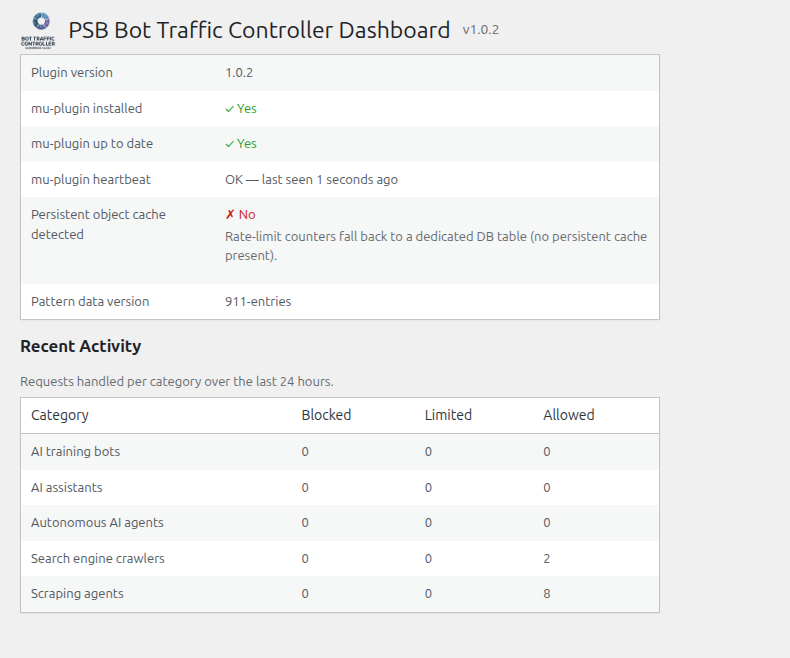
- Add per-category, per-action activity recording (
Botpolice_Activity_Recorderand the
mu-plugin’s own inline counter), surfaced on the dashboard’s Recent Activity view. - Add a token-gated debug endpoint (
?botpolice_reset=<token>) to clear rate-limit counters
for iterative live-site testing without waiting out hourly buckets. - Add a curl-based live end-to-end test suite (
tests/live/test-live-site.sh,
make test-live) verifying block/limit/allow enforcement against a real deployed site.
0.1.1
- Fix: mu-plugin helper functions were declared conditionally (inside
function_exists()
guards) but called from a closure defined before those declarations executed — PHP only
hoists unconditional top-level function declarations, so any request matching a bot pattern
hit a fatal “call to undefined function” error, blocking all traffic on the plugin’s
highest-risk hot path. Passed a plainphp -llint check without complaint. Caught by a new
subprocess-based regression suite (tests/php/mu-bootstrap/), since PHPUnit cannot safely
interceptexit()-calling code in-process.
0.1.0
- Initial development release: regex/User-Agent detection engine (911 pattern entries across
5 categories, built from matomo-org/device-detector, crawler-user-agents, and ai.robots.txt),
policy engine (block/limit/allow per category plus a global rate cap), rate limiter
(transients or DB-table-backed), mu-plugin-based early interception with a
WP-API-backed fallback layer, Settings/Dashboard admin UI, and installable-zip packaging.